core
programs take place within an idyllic Nature setting leased from and
stewarded by the First Nations people to whom it belongs,
A challenge will be in finding donors who are aligned with the Centre's
principles. We would not wish to be a vehicle for greenwashing a
company that violates human rights or manufactures toxic products. The
"white savior", commercialized RED campaign videos are an example of
what I would hope PLCC would not need to resort to for funding, nor to a
tobacco company or environmental polluter. One
strategy is to research companies for their ethics and practices, as
well as examine their donor history before approaching. Another is to
approach celebrities who have fund raised for HIV/AIDS, and who would
like a permanent legacy. An example of a celebrity creating a centre
(for musicians) that isn't high profile but functional, is Sarah McLachlan's School of Music,
which has been for years providing quality education for children at 0
cost in three cities. Companies and wealthy individuals regularly seek
opportunities to invest in social justice projects and in tax write
offs. They can also be of significant benefit in assisting with
management practicalities, as successful companies often have the best
consultants.The land, 100 forested acres, will be purchased by PLCC, gifted back to the Indigenous tribe who historically are its stewards,
and leased in perpetuity from this tribe. Tribal members are considered
first for our unionized and contract positions, with the proviso the
employee agrees with our policies and to take our trainings. Tribal
members have exclusive access to the northern stream on the property for
purposes of fishing, and to the whole of the land for activities of
gathering wood, fungi and medicinal plants in a sustainable, traditional
manner. Governmental Parks authorities coceptualized and enforced our
parks to be "safe" from Indigenous people and their activities; PLCC
will do its small part to reverse this little-known aspect of genocide
and appropriation. Settlers must confine gathering activities to the
Food Forest.
How Indigenous fishers and gatherers will be identifiable to to others
(so that settlers can be halted if appropriating Indigenous resources),
will be worked out with a tribal committee. PEER NAVS cda cnsl food forest rape relief
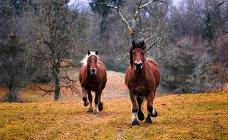
Equine importation was highly impactful. The prevailing theory is that the Spaniards introduced horses into New Mexico in the late 1500’s, and thus horses spread throughout the Americas. This allowed Plains Indigenous people much greater latitude in travel and trade, and efficiency in buffalo hunting. Riders were more formidable in war, and some tribes gained power over others. Horses allowed the Sioux to dominate territory from the Black Hills to the Mississippi River.[1]
However, there is abundant geologic evidence, and oral Indigenous histories that the modern form of equine has been present since the Pliocene Epoch. Spanish written records indicate that Indigenous peoples in the Carolinas and Georgia had horses in 1521. Oral Indigenous histories have been consistently discounted by academics, and written descriptions by invaders portray small, pony-like mounts bearing little physical and behavioral resemblance to the Conquistadors’ majestic animals. Nor would the sheer number of horses witnessed throughout the Americas have been able to proliferate within asserted time frames. Multiple pre-Columbian horse figurines and carvings found in geological expeditions, have been dismissed due to bias.[2] Cree people are conserving the descendants of the Ojibwe Horse, whom they state have always been with them. DNA testing has proven them to be of different genetics than the Spanish horses.[3] There are three main Eurocentric reasons to falsely deem horses as solely an imported species: their value to the North American economy in meat export, the value of slaughter as a disposal system for race and sport horse breeders,[4] and pressure from the cattle industry to use public rangelands exclusive of wild horses. While conservationists fight to protect them, mustangs are rapidly disappearing.[5]
[1] Edwards et al., America’s History, 16[2] Yvette Running Horse Collin, The Relationship Between the Indigenous Peoples of the Americas and the Horse: Deconstructing a Eurocentric Myth, (Doctor of Philosophy
Dissertation, University of Alaska Fairbanks, 2017): 29-31, 47, 53. https://ojibwehorse.ca/wp-
content/uploads/2019/05/Dissertation-Yvette-Running-Horse-Collin.pdf
[3] Beaulne-Stuebing, Laura, “Ojibwe horses are endangered, but a few Canadian ranches are determined to keep them alive,” CBC Radio, October 15, 2022. https://www.cbc.ca/radio/unreserved/ojibwe-spirit-horses-1.6612491
[4] Canadian Horse Defense Coalition. “Defending horses, because they can’t defend themselves.” Canada butchers alive 160,000 horses annually. Alberta has a mustang hunting season for the benefit of its cattle ranchers. https://canadianhorsedefencecoalition.org/
[5] American Wild Horse Campaign, “The Problem: A costly and cruel federal program seeks to wipe out mustangs and burros from our public lands,” American Wild Horse Campaign. https://americanwildhorsecampaign.org/problem
< This is a Headline />
This is a paragraph. To edit this paragraph, highlight the text and replace it with your own fresh content. Moving this text widget is no problem. Simply drag and drop the widget to your area of choice. Use this space to explain the products you offer and why your site visitors need them.
< Follow us />


© Copyright Gender Studies